/*! elementor – v3.11.5 – 14-03-2023 */
.elementor-heading-title{padding:0;margin:0;line-height:1}.elementor-widget-heading .elementor-heading-title[class*=elementor-size-]>a{color:inherit;font-size:inherit;line-height:inherit}.elementor-widget-heading .elementor-heading-title.elementor-size-small{font-size:15px}.elementor-widget-heading .elementor-heading-title.elementor-size-medium{font-size:19px}.elementor-widget-heading .elementor-heading-title.elementor-size-large{font-size:29px}.elementor-widget-heading .elementor-heading-title.elementor-size-xl{font-size:39px}.elementor-widget-heading .elementor-heading-title.elementor-size-xxl{font-size:59px}
Interpreting Protocol II
/*! elementor – v3.11.5 – 14-03-2023 */
.elementor-column .elementor-spacer-inner{height:var(–spacer-size)}.e-con{–container-widget-width:100%}.e-con-inner>.elementor-widget-spacer,.e-con>.elementor-widget-spacer{width:var(–container-widget-width,var(–spacer-size));–align-self:var(–container-widget-align-self,initial);–flex-shrink:0}.e-con-inner>.elementor-widget-spacer>.elementor-widget-container,.e-con-inner>.elementor-widget-spacer>.elementor-widget-container>.elementor-spacer,.e-con>.elementor-widget-spacer>.elementor-widget-container,.e-con>.elementor-widget-spacer>.elementor-widget-container>.elementor-spacer{height:100%}.e-con-inner>.elementor-widget-spacer>.elementor-widget-container>.elementor-spacer>.elementor-spacer-inner,.e-con>.elementor-widget-spacer>.elementor-widget-container>.elementor-spacer>.elementor-spacer-inner{height:var(–container-widget-height,var(–spacer-size))}
/*! elementor – v3.11.5 – 14-03-2023 */
.elementor-widget-tabs.elementor-tabs-view-vertical .elementor-tabs-wrapper{width:25%;flex-shrink:0}.elementor-widget-tabs.elementor-tabs-view-vertical .elementor-tab-desktop-title.elementor-active{border-right-style:none}.elementor-widget-tabs.elementor-tabs-view-vertical .elementor-tab-desktop-title.elementor-active:after,.elementor-widget-tabs.elementor-tabs-view-vertical .elementor-tab-desktop-title.elementor-active:before{height:999em;width:0;right:0;border-right-style:solid}.elementor-widget-tabs.elementor-tabs-view-vertical .elementor-tab-desktop-title.elementor-active:before{top:0;transform:translateY(-100%)}.elementor-widget-tabs.elementor-tabs-view-vertical .elementor-tab-desktop-title.elementor-active:after{top:100%}.elementor-widget-tabs.elementor-tabs-view-horizontal .elementor-tab-desktop-title{display:table-cell}.elementor-widget-tabs.elementor-tabs-view-horizontal .elementor-tab-desktop-title.elementor-active{border-bottom-style:none}.elementor-widget-tabs.elementor-tabs-view-horizontal .elementor-tab-desktop-title.elementor-active:after,.elementor-widget-tabs.elementor-tabs-view-horizontal .elementor-tab-desktop-title.elementor-active:before{bottom:0;height:0;width:999em;border-bottom-style:solid}.elementor-widget-tabs.elementor-tabs-view-horizontal .elementor-tab-desktop-title.elementor-active:before{right:100%}.elementor-widget-tabs.elementor-tabs-view-horizontal .elementor-tab-desktop-title.elementor-active:after{left:100%}.elementor-widget-tabs .elementor-tab-content,.elementor-widget-tabs .elementor-tab-title,.elementor-widget-tabs .elementor-tab-title:after,.elementor-widget-tabs .elementor-tab-title:before,.elementor-widget-tabs .elementor-tabs-content-wrapper{border:1px #d4d4d4}.elementor-widget-tabs .elementor-tabs{text-align:left}.elementor-widget-tabs .elementor-tabs-wrapper{overflow:hidden}.elementor-widget-tabs .elementor-tab-title{cursor:pointer;outline:var(–focus-outline,none)}.elementor-widget-tabs .elementor-tab-desktop-title{position:relative;padding:20px 25px;font-weight:700;line-height:1;border:solid transparent}.elementor-widget-tabs .elementor-tab-desktop-title.elementor-active{border-color:#d4d4d4}.elementor-widget-tabs .elementor-tab-desktop-title.elementor-active:after,.elementor-widget-tabs .elementor-tab-desktop-title.elementor-active:before{display:block;content:””;position:absolute}.elementor-widget-tabs .elementor-tab-desktop-title:focus-visible{border:1px solid #000}.elementor-widget-tabs .elementor-tab-mobile-title{padding:10px;cursor:pointer}.elementor-widget-tabs .elementor-tab-content{padding:20px;display:none}@media (max-width:767px){.elementor-tabs .elementor-tab-content,.elementor-tabs .elementor-tab-title{border-style:solid solid none}.elementor-tabs .elementor-tabs-wrapper{display:none}.elementor-tabs .elementor-tabs-content-wrapper{border-bottom-style:solid}.elementor-tabs .elementor-tab-content{padding:10px}}@media (min-width:768px){.elementor-widget-tabs.elementor-tabs-view-vertical .elementor-tabs{display:flex}.elementor-widget-tabs.elementor-tabs-view-vertical .elementor-tabs-wrapper{flex-direction:column}.elementor-widget-tabs.elementor-tabs-view-vertical .elementor-tabs-content-wrapper{flex-grow:1;border-style:solid solid solid none}.elementor-widget-tabs.elementor-tabs-view-horizontal .elementor-tab-content{border-style:none solid solid}.elementor-widget-tabs.elementor-tabs-alignment-center .elementor-tabs-wrapper,.elementor-widget-tabs.elementor-tabs-alignment-end .elementor-tabs-wrapper,.elementor-widget-tabs.elementor-tabs-alignment-stretch .elementor-tabs-wrapper{display:flex}.elementor-widget-tabs.elementor-tabs-alignment-center .elementor-tabs-wrapper{justify-content:center}.elementor-widget-tabs.elementor-tabs-alignment-end .elementor-tabs-wrapper{justify-content:flex-end}.elementor-widget-tabs.elementor-tabs-alignment-stretch.elementor-tabs-view-horizontal .elementor-tab-title{width:100%}.elementor-widget-tabs.elementor-tabs-alignment-stretch.elementor-tabs-view-vertical .elementor-tab-title{height:100%}.elementor-tabs .elementor-tab-mobile-title{display:none}}
Traditional Interpreter Roles
Designated Interpreter Role
Role in Indigenous Contexts
Traditional Interpreter Roles
In general, interpreters in non-Indigenous settings have taken on a role that strives for very little interference, influence, or manifestation of the interpreter’s engagement as a separate entity. This stems from a history of
ethically trying to do no harm. This has led to the stigmatization of the old role model labels such as “helper,” and leads to the more accepted term of “ally.”
However, the role of designated interpreter (DI) has slowly come to be a mixture of the behaviors of many of these old and new roles, with, perhaps, some enhancements.
Designated Interpreter Role
A DI’s role can vary hour by hour or day by day. Each Deaf professional (DP) has different needs at different times, which should be part of the DP/DI team planning. A DI works closely with a DP, so much so that his/her knowledge of the setting and context of the DP’s work is in-depth. Many of the interpreted situations go smoothly because the DI can anticipate or predict what a DP will express before they start a sentence. The DI and DP become a team. The DI can and should interact with the DP’s hearing colleagues as a separate individual, showing their humanity. This ensures trust and smooth collaboration between the hearing and DP/DI team. It also allows for the DI (and thus the DP) to understand the contextual culture of the work environment. Rumors, inside jokes, stories about who ate the last donut in the break room, and general information become mandatory interpreter knowledge to convey to the DP. Being a DI allows the power imbalance between hearing colleagues (including interpreter) and Deaf to begin to balance out. A team must be flexible and cohesive. A DI must adapt to situations quickly and smoothly, giving information from the environment to the DP. DP/DI teams save time and lower stress. By showing adaptability, DPs have more opportunity to advance their careers. With professional assigned interpreters of a more neutral role, DPs become frustrated when working with non-designated interpreters who are unfamiliar with interpreting in Indigenous terminology, acronyms, context and cultural norms.
Role in Indigenous Contexts
The specific cultural and ethical expectations in Indigenous contexts are paramount when considering your interpreting role — behaviors and perceptions. Knowing the complexities of such an assignment discussed in this Protocol, a non-Indigenous interpreter should shift towards a more designated interpreter role: expect that you will be addressed as the person you are, and
need to interact on your own behalf, as well as providing constant communication access to whomever needs it, just as in the above role explanation of a DI. This means preparations are much more than reviewing the text of a presentation or knowing the names of participants. Preparation includes learning that setting’s schema. For example, as a field interpreter, you may be expected to participate in whatever type of physical work your DP is engaging in; if all of the women of the family are gathering berries, and your DP is helping, the DI will be gathering berries, too — this is a show of reciprocity on the part of the interpreter. You must also recognize your privilege and the power disparity between some Indigenous Deaf and their hearing tribal members. Deaf tribal members may lack tribal knowledge, understanding, or have misconceptions due to lack of communication and/or education. You must be adaptable, with respect. Respect that you have power that must be used with responsibility to the people. The people and their relationships are more important than the work.
Diagrams to be used for powwows, signing circles, meetings, and ceremonies
Prayer Ceremony Circle
Mohawk Spiritual Gathering
Two interpreters in Semi-Circle
Interpreters Talking/Signing Circle
Prayer Ceremony Circle
 This is a prayer ceremony circle created by Melanie McKay-Cody for the purpose of full language access to hearing and Deaf Indigenous (and non-Indigenous) people. The Indigenous Spiritual Leader or Person who leads the Prayer will stand in the middle of the circle and sign the Prayer. There are 4 hearing interpreters who are at the right side of the person signing the Prayer and on the left side will be Deaf “shadow” interpreter for the other Deaf people to see when the person in the middle is facing the other direction.
Mohawk Spiritual Gathering
 The Spiritual gathering circle was created by Tina Terrance of the Mohawk tribe in New York, in 2006. The circle can be used as a Prayer Circle or “meeting” circle where everyone gathers together to talk in the circle.
Two interpreters in Semi-Circle
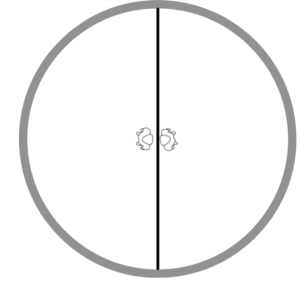 When there are only two interpreters at a site, and if there are hearing participants in
the circle with Deaf participants, the interpreters will position themselves within a semi-
circle. Melanie McKay-Cody creates this; it can be for a Signing/Talking circle or meeting
circle.
Interpreters Talking/Signing Circle
 This is very symbolic of Indigenous culture, where the four cardinal directions are set
in the middle of the Signing/talking circle that involves hearing and Deaf Indigenous
participants (it can be used for other purposes in the circle). This is created by Melanie
McKay-Cody.
Interpreter + Pow-Wow Dancer
Interpreters in Cardinal Directions
Same-Gender Sweat Lodge
All-Gender Sweatlodge
Interpreter + Pow-Wow Dancer
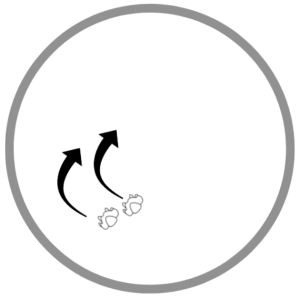 This is an example where the interpreter is involved with the dancer; they dance
together and the interpreter will interpret what is being said by the Emcee, or other
announcements. This is created by James Wooden Legs.
Interpreters in Cardinal Directions
 The interpreters standing in four cardinal directions and symbolic of our Indigenous
culture, the Indigenous/Native Deaf dancer(s) will be able to see interpreters at their line of
vision while s/he or they move around the circle at Pow Wow or any dance event. It is
produced by James Wooden Legs.
Same-Gender Sweat Lodge
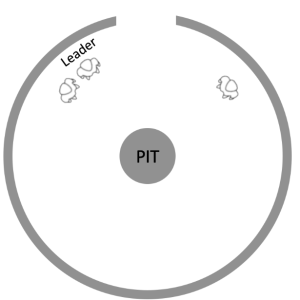 This is a typical sweat lodge where the interpreter sits next to the Spiritual leader or at
the opposite side of the flap of the sweat lodge. This is developed by consensual agreement
from past Intertribal Deaf members. The position of the interpreter can be adjusted depending
on the sweat lodge Deaf participant and/or DeafBlind participant. Typically the DeafBlind
interpreter will sit next to the DeafBlind participant anywhere within the sweat lodge.
All-Gender Sweatlodge
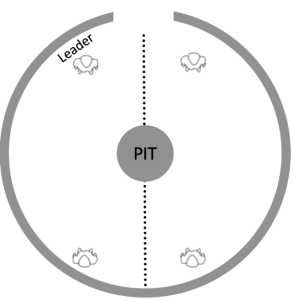 This sweat lodge positioning was created by past Intertribal Deaf members. The
leader sits near the “door” of the sweat lodge. At the back of the sweat lodge, one side is the
female side, and the female interpreter sits in that place. On the opposite side is the male
interpreter. The one by the door either follows the gendered side or either gender interpreter
can sit there. It is important to ask the Spiritual leader which is the most appropriate
placement because she or he is in charge of the sweat lodge. If the Spiritual leader has never
conducted one with a Deaf participant, the responsibility is transferred to the Indigenous Deaf
participant to decide the position.
This protocol has been developed by Melanie McKay-Cody (Cherokee), Armando Castro (Mixteca), Tim Curry (Non-Indigenous), Amy Fowler (Non-Indigenous), Ren Freeman (Eastern Shoshone/First Nation Cree), Crescenciano Garcia, JR. (Aztec), Paola Morales
(Nahua/Pipil and afromestiza) Evelyn Optiz (San Carlos Apache) and Wanette Reynolds (Cherokee). Reviewed by Kevin Goodfeather (Dakota), Natasha Terry (Navajo), Hallie Zimmerman (Winnebago), and James Wooden Legs (Northern Cheyenne).
Citation: McKay-Cody, Melanie, “Memory Comes Before Knowledge-North American Indigenous Deaf: Socio-cultural Study of Rock/Picture Writing, Community, Sign Languages, and Kinship.” Published Ph.D. Diss., University of Oklahoma, 312-325.
 TIHT
TIHT 