/*! elementor – v3.10.0 – 09-01-2023 */
.elementor-heading-title{padding:0;margin:0;line-height:1}.elementor-widget-heading .elementor-heading-title[class*=elementor-size-]>a{color:inherit;font-size:inherit;line-height:inherit}.elementor-widget-heading .elementor-heading-title.elementor-size-small{font-size:15px}.elementor-widget-heading .elementor-heading-title.elementor-size-medium{font-size:19px}.elementor-widget-heading .elementor-heading-title.elementor-size-large{font-size:29px}.elementor-widget-heading .elementor-heading-title.elementor-size-xl{font-size:39px}.elementor-widget-heading .elementor-heading-title.elementor-size-xxl{font-size:59px}
Interpreting Resources
Interpreting Protocol
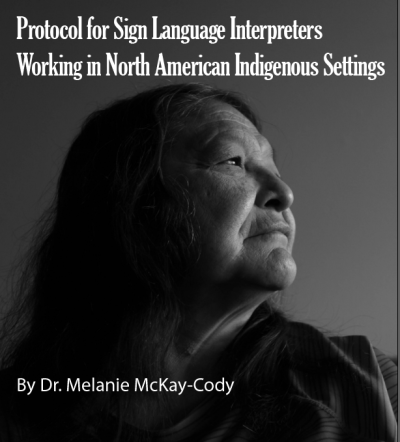 Dr. Melanie McKay-Cody, presenting to you this protocol for interpreting in native settings. This topic arose because Indigenous Deaf people felt that ITPs and other interpreter preparation programs don’t meet our communal needs. The training is not appropriate for interpreting in native settings. Due to many issues related to that, we decided to establish this protocol. The work on this protocol started in July 2018 as we carefully crafted the different pieces and finally made it ready for publication and dissemination in May 2019. In this protocol we emphasize the five R’s: Respect, Relationship, Responsibility, Relevance, and Reciprocity. This represents our way of knowing, being, and doing, and is part of our Indigenous Deaf Methodologies, as opposed to Western philosophies used in many ASL and Deaf studies programs.
Note: For all jobs/assignments that Sign Language Interpreters conduct, every interpreter must have credentials
 TIHT
TIHT 